The Sorrowful Mysteries walk with Christ through His Passion and death. They invite us to stand with Mary at the foot of the Cross — to enter into suffering, to unite our own pain with His, and to receive from His wounds the grace of redemption.
The Sorrowful Mysteries are the set of the Rosary that meditate on the Passion of Christ: the Agony in the Garden, the Scourging at the Pillar, the Crowning with Thorns, the Carrying of the Cross, and the Crucifixion. Catholics pray them on Tuesdays and Fridays.
✦ Traditionally prayed on Tuesday and Friday
Also prayed on all Sundays of Lent, in place of the Glorious Mysteries. These Mysteries correspond to the most penitential days and seasons of the liturgical year. For praying the Rosary on these days in particular, see the Tuesday Rosary and the Friday Rosary.
◆ When to Pray the Sorrowful Mysteries
Standard days
Tuesday and Friday, year-round
Lenten Sundays
The Sorrowful Mysteries replace the Glorious Mysteries on all Sundays of Lent, aligning the Passion cycle with the Church’s most penitential season
Good Friday
Traditionally the most fitting single day for the Sorrowful Mysteries — Christ’s Passion prayed on the day of the Passion
Stations of the Cross
The Sorrowful Mysteries complement the Stations of the Cross; many communities pray them together on Fridays during Lent
Schedule authority
John Paul II, Rosarium Virginis Mariae §38 (2002); long-standing Dominican tradition prior to 2002
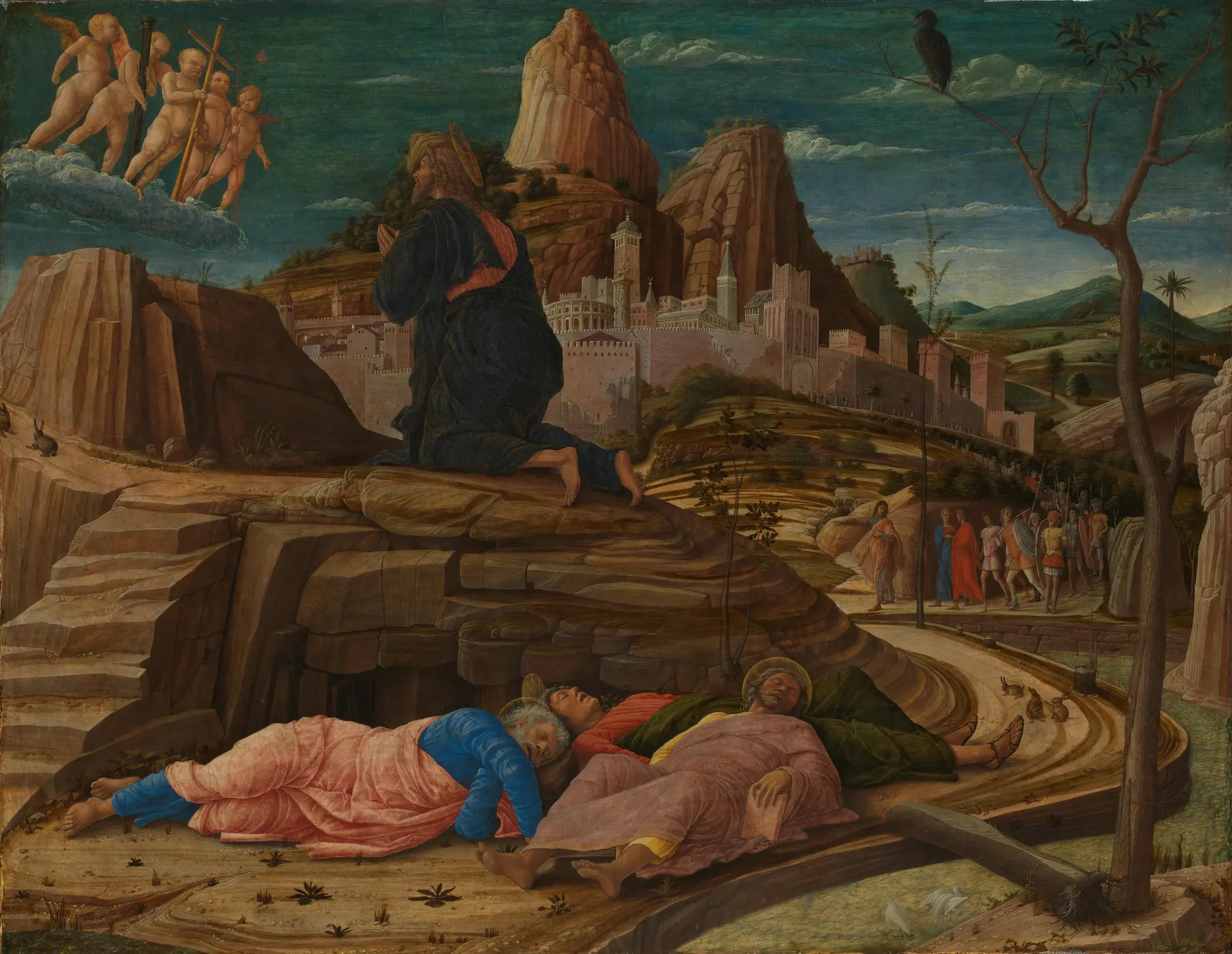
Andrea Mantegna, The Agony in the Garden, c. 1458 to 1460. National Gallery, London.
My Father, if it be possible, let this chalice pass from me. Nevertheless not as I will, but as thou wilt. Matthew 26:39
Jesus kneels in the Garden of Gethsemane the night before His death, in such anguish that His sweat becomes like drops of blood (Luke 22:44). He prays three times: let this chalice pass — yet not my will but the Father’s. He finds His disciples asleep: they cannot watch even one hour. He faces His Passion in radical solitude. This is the mystery of freedom: God in His humanity choosing the Cross, surrendering His will entirely to the Father. The fruit is that God’s will be done — the prayer that what He asks of us may come to pass, even when it costs everything.
Why God’s Will Be Done?
God’s Will Be Done flows from the Agony because Gethsemane is the supreme moment of aligned will — a human will freely submitted to the divine will at its costliest. Jesus prays three times: “not as I will, but as thou wilt” (Matthew 26:39). This is not passive resignation but the most violently active choice imaginable: choosing the Cross against every natural instinct. Thomas Aquinas, quoting Gregory the Great: “Obedience is rightly preferred to sacrifices, because by sacrifices another’s body is slain whereas by obedience we slay our own will” (ST II–II, Q. 104, citing Moralia XXXV). Hebrews: “whereas indeed he was the Son of God, he learned obedience by the things which he suffered” (Hebrews 5:8). Luke 22:44 records the hematohidrosis in the Greek word thromboi — clots, not mere drops — noted only by Luke, who was a physician (Colossians 4:14). The fruit is the surrender that can pray “not my will” and mean it: fiat voluntas tua, thy will be done.
Sources: Matthew 26:39 · Thomas Aquinas, ST II–II, Q. 104 (citing Gregory the Great, Moralia XXXV) · Hebrews 5:8 · Luke 22:44 (Greek: thromboi; Luke as physician: Colossians 4:14)
“There Jesus encounters all the temptations and confronts all the sins of humanity, in order to say to the Father: ‘Not my will but yours be done.’ This ‘Yes’ of Christ reverses the ‘No’ of our first parents in the Garden of Eden.” John Paul II, Rosarium Virginis Mariae §22
Sacred site: Basilica of All Nations (Church of the Agony), Gethsemane — built 1924 by Antonio Barluzzi. Ancient olive trees in the adjacent garden may trace root systems to the first century. A rock inside the basilica is venerated as the place of Christ’s prayer.
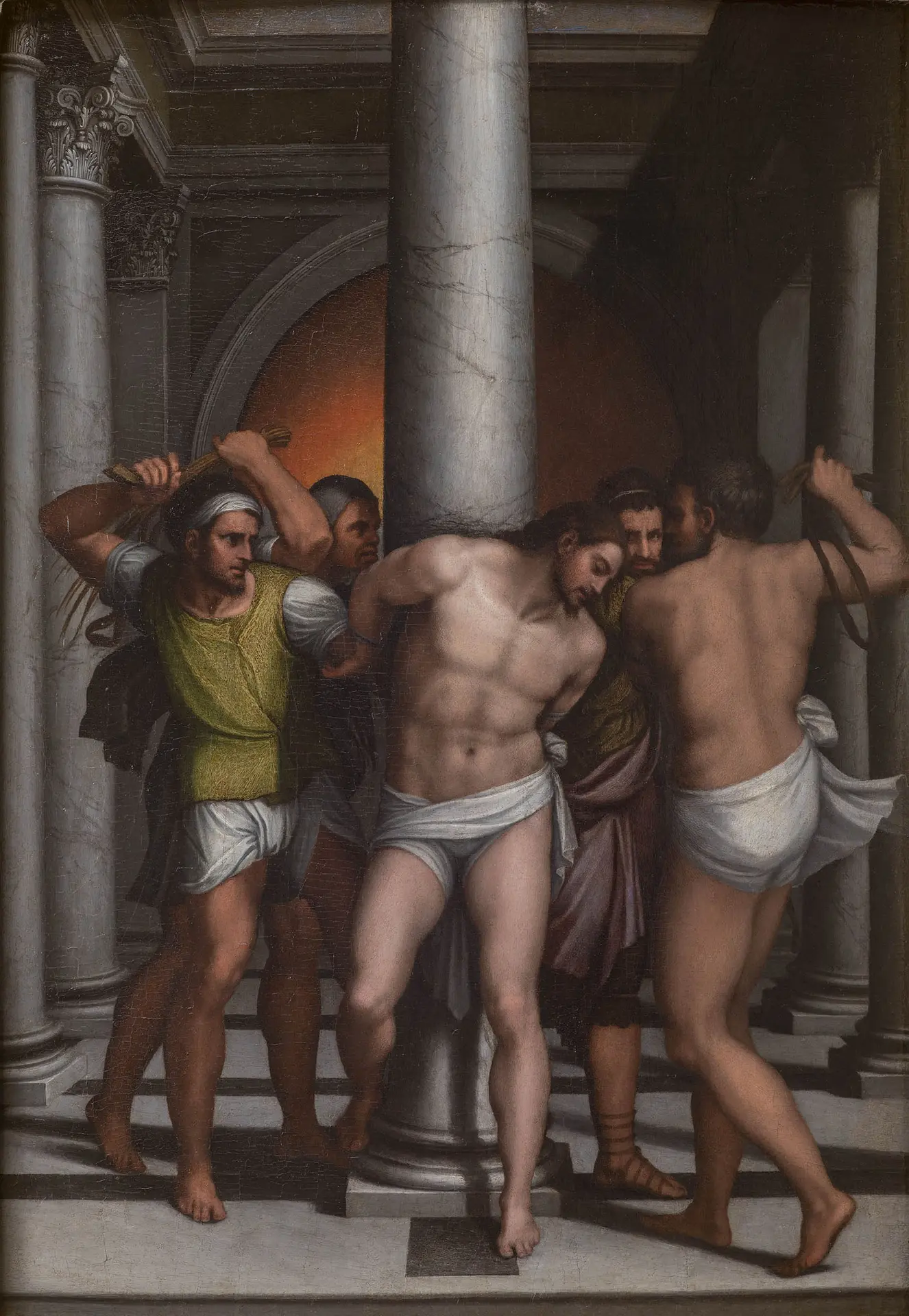
Then he released to them Barabbas, and having scourged Jesus, delivered him unto them to be crucified. Matthew 27:26
Jesus, innocent of all charge, is bound to a pillar and scourged by Roman soldiers. His body — which will rise in glory — is broken by the sin of the world. The Fathers of the Church saw in this Mystery the suffering taken on by Christ for every failure of human bodies to be temples of the Holy Spirit. Isaiah’s prophecy is fulfilled: "by his bruises we are healed" (Isaiah 53:5). The fruit is purity — not hatred of the body, but the chastening of desire that keeps it a temple, turning appetite and impulse toward God rather than away from Him.
Why Purity?
Purity flows from the Scourging because the mystery is Christ’s own flesh torn for the sins of the flesh — and so the wellspring of the purity he restores to the body. The primary Gospel citation is John 19:1: Pilate’s direct order. The Roman flagrum — leather thongs embedded with bone or metal tips (plumbatae) — left the body torn; Jewish law capped stripes at thirty-nine (Deuteronomy 25:3; 2 Corinthians 11:24), but Rome observed no such limit. Isaiah foretold it: “by his bruises we are healed” (Isaiah 53:5). Paul names the dignity the Scourging defends: “Know you not, that your members are the temple of the Holy Ghost?” (1 Corinthians 6:19), and so “glorify and bear God in your body” (1 Corinthians 6:20). Thomas Aquinas locates purity within temperance — the right ordering of bodily desire so that the body serves love rather than ruling it (ST II–II, Q. 151). The fruit is purity: not contempt for the body but reverence for it, the chastening of appetite that keeps the body what Christ’s wounds make it again — a temple.
Sources: John 19:1 · Isaiah 53:5 · 1 Corinthians 6:19–20 · Thomas Aquinas, ST II–II, Q. 151
“And the cost of this faithfulness to the Father’s will is made clear in the following mysteries; by his scourging, his crowning with thorns, his carrying the Cross and his death on the Cross, the Lord is cast into the most abject suffering: Ecce homo!” John Paul II, Rosarium Virginis Mariae §22
Sacred site: Church of the Flagellation, Jerusalem — Franciscan church on the traditional site of the Praetorium; current structure 1929. The adjacent Convent of the Sisters of Zion preserves a Roman pavement (Lithostrotos) dating to Hadrianic Jerusalem.
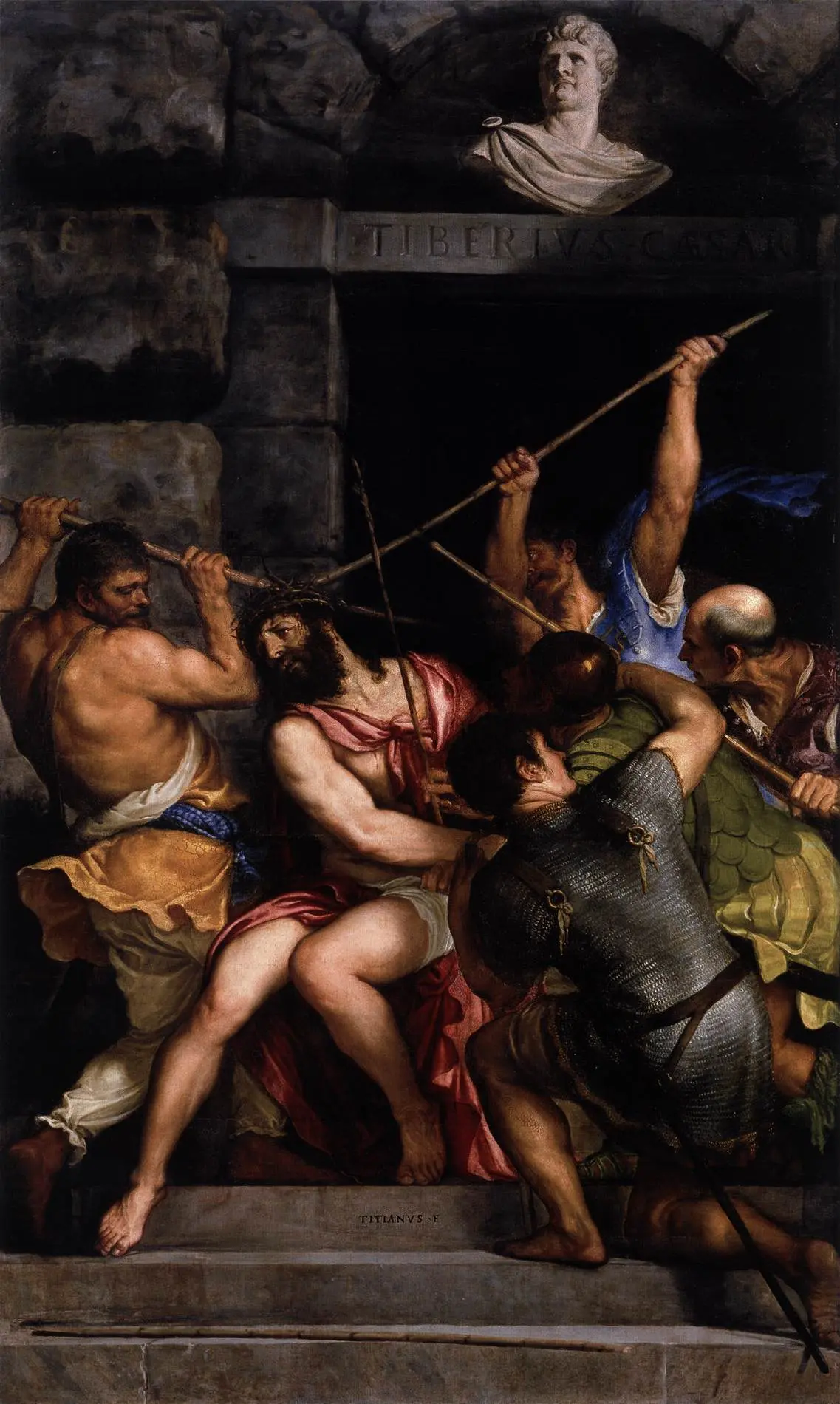
Titian, Christ Crowned with Thorns, c. 1542 to 1543. Louvre, Paris.
Fruit of the Mystery: Reign of Christ in Our Hearts
Then the soldiers of the governor taking Jesus into the hall, gathered together unto him the whole band; and stripping him, they put a scarlet cloak about him. And platting a crown of thorns, they put it upon his head, and a reed in his right hand. And bowing the knee before him, they mocked him, saying: Hail, King of the Jews. Matthew 27:27-29
The soldiers dress Jesus in mock royal robes, press thorns into His head, and kneel before Him in obscene parody of worship. They spit and strike. Jesus endures it in silence. He who is truly King accepts being treated as a fool. The Crowning with Thorns confronts us with every act of pride and contempt we have directed at others — and at God. The fruit is the reign of Christ in our hearts: the enthroning of the mocked King as the true Lord of our thoughts, choices, and loves.
Why the Reign of Christ in Our Hearts?
The Reign of Christ in Our Hearts flows from the Crowning because the soldiers, meaning only mockery, proclaim the truth: this is the King. They throw a scarlet cloak about him, press a crown of thorns into his head, set a reed in his hand for a sceptre, and bow the knee — “Hail, King of the Jews” — a parody that is, unknowingly, a coronation. The kingship the world crowns with thorns is the kingship the Church confesses: “he hath on his garment, and on his thigh written: King of kings, and Lord of lords” (Apocalypse 19:16). Pope Pius XI, establishing the feast of Christ the King, taught that his reign is exercised not by force but over the minds, wills, and hearts that freely submit to him (Quas Primas, 1925). To let Christ reign is to dethrone the rival kings — pride, fear, the opinion of others — that the Crowning holds up to view. Thomas Aquinas describes the New Law itself as chiefly the grace of the Holy Spirit written on the heart (ST I–II, Q. 106, a. 1). The fruit is the reign of Christ in our hearts: the deliberate enthroning of the mocked King as the true Lord of one’s thoughts, choices, and loves.
Sources: Matthew 27:27–29 · Apocalypse 19:16 · Pope Pius XI, Quas Primas (1925) · Thomas Aquinas, ST I–II, Q. 106, a. 1
“This abject suffering reveals not only the love of God but also the meaning of man himself.” John Paul II, Rosarium Virginis Mariae §22
Sacred site: The Praetorium, Jerusalem — Church of the Flagellation (traditional site). The Crown of Thorns relic is held in the Treasury of Notre-Dame de Paris; it survived the 2019 fire and is exposed for veneration on designated Fridays in Lent.
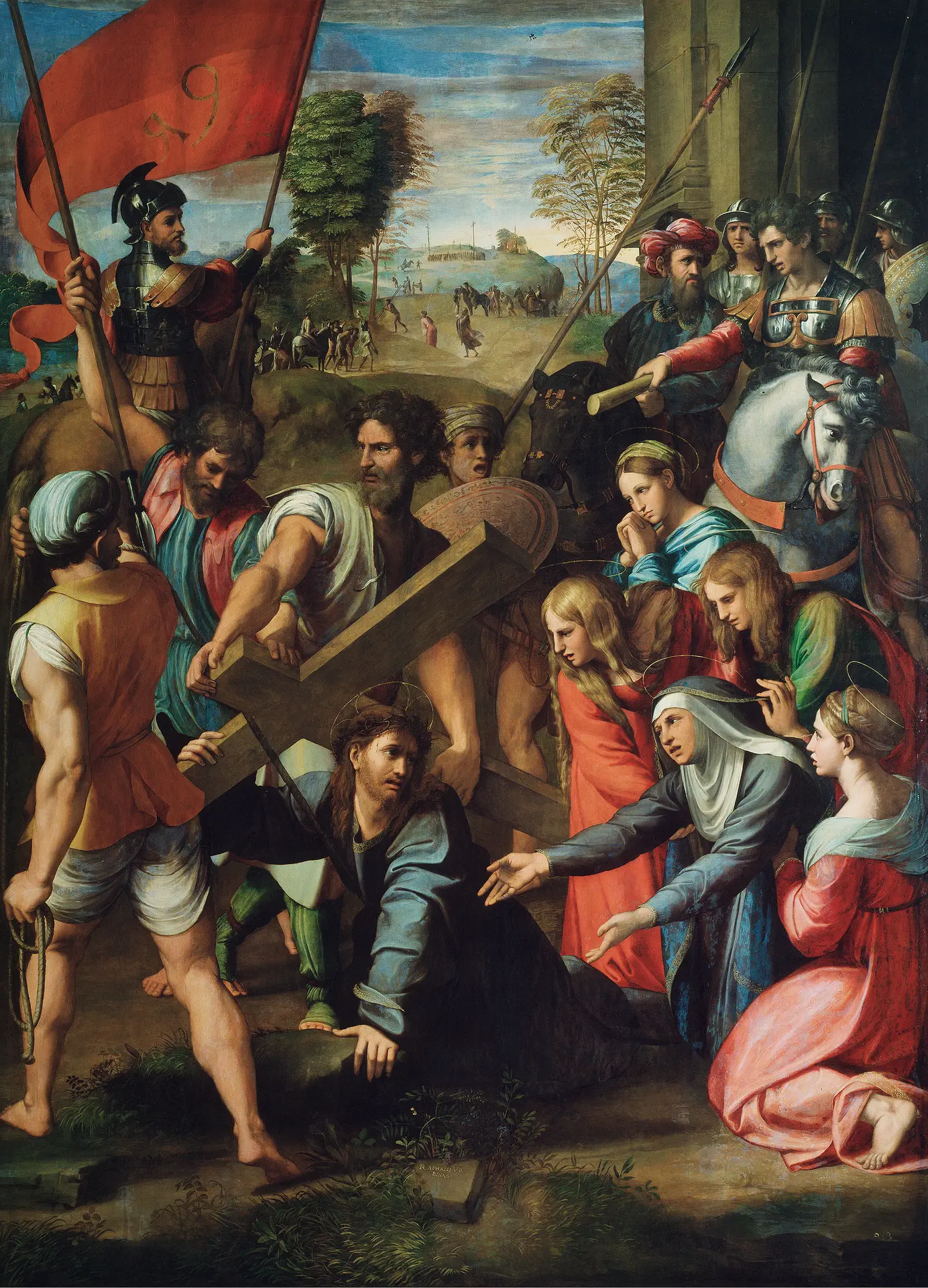
Raphael, Christ Falling on the Way to Calvary (Lo Spasimo di Sicilia), c. 1515 to 1516. Museo del Prado, Madrid.
And they forced one Simon a Cyrenian who passed by, coming out of the country, the father of Alexander and of Rufus, to take up his cross. And they bring him into the place called Golgotha, which being interpreted is, The place of Calvary. Mark 15:21-22
Jesus carries the Cross through the streets of Jerusalem — the Via Dolorosa — to Calvary. He falls under its weight. Simon of Cyrene is conscripted to help. Jesus encounters His Mother, Veronica, the weeping women of Jerusalem. He accepts this suffering not as meaningless but as the path the Father has given Him. "And whosoever doth not carry his cross and come after me, cannot be my disciple" (Luke 14:27). We carry ours after His. The fruit is the patient bearing of trials: endurance in suffering without bitterness, offering what we carry in union with Christ.
Why the Patient Bearing of Trials?
The Patient Bearing of Trials flows from the Carrying because the mystery is the pattern of all Christian suffering: not the removal of the burden but its bearing without bitterness, in union with the One who walked this road first. Thomas Aquinas defines patience as the virtue that prevents suffering from producing disordered sorrow — the bitterness that would harm the soul more than the suffering itself (ST II–II, Q. 136). Paul traces its arc: “tribulation worketh patience; and patience trial; and trial hope; and hope confoundeth not” (Romans 5:3–5). Mark’s detail that Simon was “the father of Alexander and of Rufus” (Mark 15:21) — names apparently known to the Roman church (cf. Romans 16:13) — suggests an involuntary compulsion became a life-changing encounter with Christ. Veronica belongs to the Church’s devotional Stations tradition; she does not appear in the canonical Gospels. The canonical witnesses on the Via Dolorosa are Simon of Cyrene (Mark 15:21) and the women of Jerusalem (Luke 23:27–28). The fruit is the patient bearing of trials: endurance in suffering without bitterness, offering what we carry in union with Christ.
Sources: Thomas Aquinas, ST II–II, Q. 136 · Romans 5:3–5 · James 1:3–4 · Mark 15:21 (cf. Romans 16:13)
“Ecce homo: the meaning, origin and fulfilment of man is to be found in Christ, the God who humbles himself out of love ‘even unto death, death on a cross’ (Phil 2:8).” John Paul II, Rosarium Virginis Mariae §22
Sacred site: The Via Dolorosa, Jerusalem — the traditional 14-station route from the Praetorium to Calvary. A Franciscan procession walks it every Friday. The route as presently marked reflects medieval tradition; the historical road passed through a slightly different quarter of the ancient city.
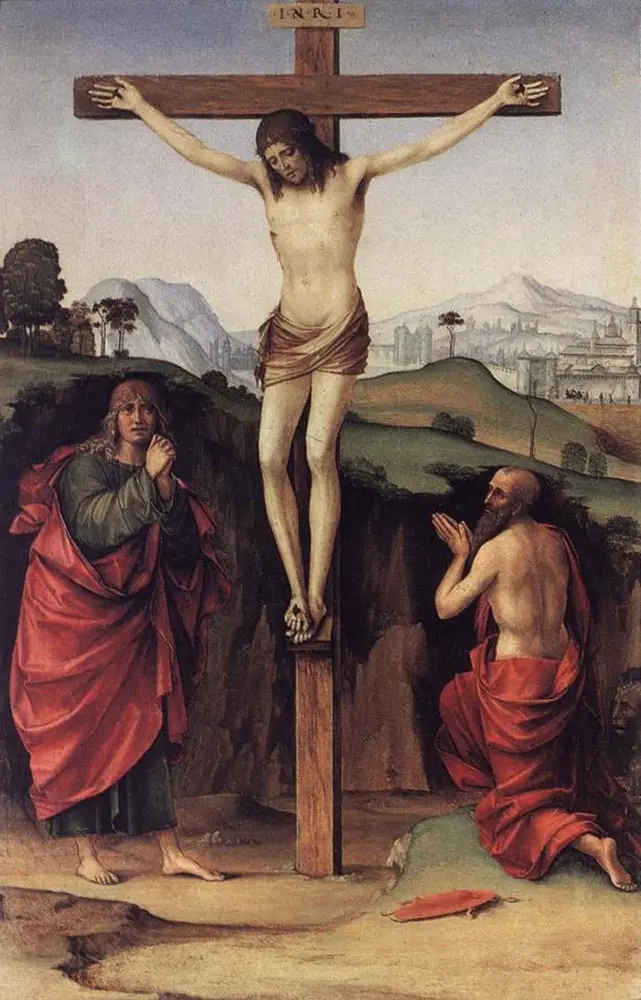
Francesco Francia or Marco Palmezzano (North Italian school), Crucifixion with Saints John and Jerome, c. 1490 to 1510.
And when they were come to the place which is called Calvary, they crucified him there; and the robbers, one on the right hand, and the other on the left. And Jesus said: Father, forgive them, for they know not what they do... And it was almost the sixth hour; and there was darkness over all the earth until the ninth hour. And the sun was darkened, and the veil of the temple was rent in the midst. And Jesus crying with a loud voice, said: Father, into thy hands I commend my spirit. And saying this, he gave up the ghost. Luke 23:33-34, 44-46
Jesus is nailed to the Cross. For three hours He hangs between two criminals, forgiving His executioners, promising paradise to the repentant thief, giving His Mother to the Beloved Disciple. He cries out in dereliction — "My God, my God, why hast thou forsaken me?" (Matthew 27:46, Psalm 22:1) — taking on himself the full abandonment of sinful humanity — and then commends His spirit to the Father. Mary stands at the foot of the Cross. The fruit is the pardoning of injuries: to forgive those who wrong us, as Christ forgave from the Cross, "Father, forgive them, for they know not what they do."
Why the Pardoning of Injuries?
The Pardoning of Injuries flows from the Crucifixion because the first word Christ speaks from the Cross is a pardon for the men driving in the nails: “Father, forgive them, for they know not what they do” (Luke 23:34). At the moment of the greatest injury ever done, the victim intercedes for those inflicting it — and makes that prayer the pattern for his disciples. He had already commanded it: “love your enemies: do good to them that hate you” (Luke 6:27), and taught his Church to pray “forgive us our debts, as we also forgive our debtors” (Matthew 6:12). The dying thief receives in that very hour what pardon looks like applied: “this day thou shalt be with me in paradise” (Luke 23:43). Augustine saw in the blood and water from the pierced side (John 19:34) the sacraments by which that pardon reaches us, the Church born from the wound sin opened (Tractatus in Johannem 120). Thomas Aquinas teaches that to love and forgive one’s enemies conforms us most nearly to God, who pardons (ST II–II, Q. 25, a. 8). The fruit is the pardoning of injuries: releasing those who have wronged us, as we ourselves have been released from the Cross.
Sources: Luke 23:34, 43 · Matthew 6:12; Luke 6:27 · Augustine, Tractatus in Johannem 120 · Thomas Aquinas, ST II–II, Q. 25, a. 8
“The sorrowful mysteries help the believer to relive the death of Jesus, to stand at the foot of the Cross beside Mary, to enter with her into the depths of God’s love for man and to experience all its life-giving power.” John Paul II, Rosarium Virginis Mariae §22
Sacred site: Church of the Holy Sepulchre, Jerusalem — both Calvary (Golgotha) and the Resurrection tomb are enclosed within the same basilica, built by Constantine in 326 AD, rebuilt by the Crusaders in 1149. During the 2016–2017 restoration, the original burial slab was exposed for the first time in centuries.
Pray the Sorrowful Mysteries now.
Orabimus guides you through every prayer with audio in English and Latin — free, no sign-in required.
Live community · Prayer streak · No account needed
What are the Sorrowful Mysteries and when are they prayed?
Each decade of the Rosary meditates on one Mystery — an event from the lives of Jesus and Mary drawn from Scripture and the tradition of the Church. For each decade: announce the Mystery, pray one Our Father, ten Hail Marys while meditating on the Mystery, then one Glory Be and the Fatima Prayer.
The five Sorrowful Mysteries are: The Agony in the Garden (Matthew 26:36-46), The Scourging at the Pillar (Matthew 27:26), The Crowning with Thorns (Matthew 27:27-31), The Carrying of the Cross (Luke 23:26-32), and The Crucifixion and Death of Our Lord (Luke 23:33-46). They are traditionally prayed on Tuesdays and Fridays.
What day are the Sorrowful Mysteries prayed?
The Sorrowful Mysteries are traditionally prayed on Tuesday and Friday throughout the year. They also replace the Glorious Mysteries on all Sundays of Lent, aligning the Passion cycle with the Church's most penitential season (John Paul II, Rosarium Virginis Mariae §38, 2002). Good Friday is the most fitting single day for this set — Christ's Passion prayed on the day of the Passion. Many communities also pray them alongside the Stations of the Cross on Fridays during Lent.
What are the fruits of the Sorrowful Mysteries?
The fruits of the Sorrowful Mysteries are: Agony in the Garden — God's Will Be Done; Scourging at the Pillar — Purity; Crowning with Thorns — Reign of Christ in Our Hearts; Carrying of the Cross — Patient Bearing of Trials; Crucifixion — Pardoning of Injuries.
Why does the Catholic Rosary meditate on the Passion?
The Rosary meditates on the Passion because the suffering and death of Christ is the heart of the Gospel — the act by which humanity is redeemed. Pope Pius XII called the Rosary 'a compendium of the entire Gospel.' To pray the Sorrowful Mysteries is to stand with Mary at the foot of the Cross and unite our own suffering with that of Christ, who redeemed all suffering from within.
What are all five Sorrowful Mysteries of the Rosary?
The five Sorrowful Mysteries are: 1. The Agony in the Garden — Jesus prays in Gethsemane and submits His will to the Father (Matthew 26:36-46). 2. The Scourging at the Pillar — Jesus is bound and scourged by Roman soldiers (Matthew 27:26). 3. The Crowning with Thorns — a crown of thorns is pressed onto Jesus's head as He is mocked as King (Matthew 27:27-31). 4. The Carrying of the Cross — Jesus carries His cross to Calvary; Simon of Cyrene is pressed into service (Mark 15:21-22). 5. The Crucifixion and Death of Our Lord — Jesus is crucified and dies on the Cross, commending His spirit to the Father (Luke 23:33-46).
What is the spiritual fruit of each Sorrowful Mystery?
The fruits (virtues) of the Sorrowful Mysteries, as given in the Dominican tradition, are: The Agony in the Garden — God's Will Be Done; The Scourging at the Pillar — Purity; The Crowning with Thorns — Reign of Christ in Our Hearts; The Carrying of the Cross — Patient Bearing of Trials; The Crucifixion and Death — Pardoning of Injuries.
What is the First Sorrowful Mystery?
The First Sorrowful Mystery is the Agony in the Garden — Jesus praying in Gethsemane on the night of his arrest, falling prostrate and sweating blood in his anguish, yet submitting his will to the Father: 'Not as I will, but as you will' (Matthew 26:39). The Mystery contemplates perfect obedience even in extreme suffering. Its spiritual fruit is obedience to God's will. It is prayed as the first decade on Tuesday and Friday, and on Sundays during Lent when the Sorrowful Mysteries are substituted for the usual Sunday mysteries.
Why is God's Will Be Done the fruit of the Agony in the Garden?
God's Will Be Done is the fruit of the Agony because Gethsemane is the supreme act of aligned will — a human will submitted to divine will at maximum cost. Jesus prays 'not as I will, but as thou wilt' (Matthew 26:39) three times. Aquinas, citing Gregory the Great: 'Obedience is rightly preferred to sacrifices, because by sacrifices another's body is slain whereas by obedience we slay our own will' (ST II-II, Q. 104; Moralia XXXV). Hebrews 5:8: 'whereas indeed he was the Son of God, he learned obedience by the things which he suffered.'
Why is Purity the fruit of the Scourging at the Pillar?
Purity is the fruit of the Scourging because Christ's own flesh is torn for the sins of the flesh — the wellspring of the purity he restores to the body. Isaiah foretold it: 'by his bruises we are healed' (Isaiah 53:5). Paul names the dignity the Scourging defends: 'Know you not, that your members are the temple of the Holy Ghost?' (1 Corinthians 6:19). Aquinas locates purity within temperance — the right ordering of bodily desire so that the body serves love rather than ruling it (ST II-II, Q. 151). The fruit is not contempt for the body but reverence for it.
Why is the Reign of Christ in Our Hearts the fruit of the Crowning with Thorns?
The Reign of Christ in Our Hearts is the fruit of the Crowning because the soldiers, meaning only mockery, proclaim the truth: this is the King. Their parody — scarlet cloak, crown of thorns, a reed for a sceptre, 'Hail, King of the Jews' — is unknowingly a coronation. Pope Pius XI taught that Christ's reign is exercised not by force but over the minds, wills, and hearts that freely submit to him (Quas Primas, 1925). To let Christ reign is to dethrone the rival kings — pride, fear, the opinion of others — the Crowning holds up to view. The fruit is the enthroning of the mocked King as the true Lord of our thoughts, choices, and loves.
Why is the Patient Bearing of Trials the fruit of the Carrying of the Cross?
The Patient Bearing of Trials is the fruit of the Carrying because the mystery is the pattern of all Christian suffering: not the elimination of the burden but its bearing without bitterness. Aquinas defines patience as the virtue that prevents suffering from producing disordered sorrow — the bitterness that would damage the soul more than the suffering itself (ST II-II, Q. 136). Paul's arc: 'tribulation worketh patience; and patience trial; and trial hope; and hope confoundeth not' (Romans 5:3-5). Jesus commands it: 'whosoever doth not carry his cross and come after me, cannot be my disciple' (Luke 14:27).
Why is the Pardoning of Injuries the fruit of the Crucifixion?
The Pardoning of Injuries is the fruit of the Crucifixion because the first word Christ speaks from the Cross is a pardon for the men driving in the nails: 'Father, forgive them, for they know not what they do' (Luke 23:34). He had already commanded it — 'love your enemies: do good to them that hate you' (Luke 6:27) — and taught his Church to pray 'forgive us our debts, as we also forgive our debtors' (Matthew 6:12). Aquinas teaches that to love and forgive one's enemies conforms us most nearly to God, who pardons (ST II-II, Q. 25, a. 8). The fruit is releasing those who have wronged us, as we ourselves have been released from the Cross.